
How-To Guide
How Much Fragrance Oil for Candles and Soap? Ratios and Temperatures

Sep
How much fragrance oil for candles? As a rule of thumb, 6 to 10 percent of the wax weight, added at 140 to 150 °F (60 to 65 °C) for soy wax. For soap, 3 to 5 percent of the oil weight. Using fragrance oil is the step that turns a plain candle or bar of soap into something special, but pouring a perfume oil straight into hot wax often ends in disappointment: the scent either disappears or changes as it burns. In this guide we cover the right ratios, temperatures and tricks.
Fragrance Oil for Candles: The Right Ratio and Temperature
In candle making, two variables decide everything: fragrance load and adding temperature.
- Fragrance load: 6 to 10 percent of the wax by weight. For 500 g (about 17.6 oz) of soy wax, that’s 30 to 50 g of fragrance oil. More won’t make the scent stronger; it hurts the burn quality and causes soot.
- Adding temperature: 140 to 150 °F (60 to 65 °C) for soy wax and 158 to 167 °F (70 to 75 °C) for paraffin. This range is critical.
Why does temperature matter so much? If you add the oil when the wax is too hot, the volatile top notes evaporate and only the heavy notes remain. If you add it when the wax is too cool, the oil won’t blend fully into the wax; you get unscented patches when it burns and oily spots on the surface.
Always check the guidance your wax supplier gives for maximum fragrance load, and make sure any fragrance oil you use is suitable for candles.
Making a Scented Candle, Step by Step
- Melt the wax in a double boiler and track the temperature with a thermometer.
- Take it off the heat and let it cool to the target temperature (140 to 150 °F for soy).
- Add the fragrance oil and stir gently for at least 2 minutes. Stir too briefly and the scent won’t distribute evenly.
- Pour into the container and let it cool slowly at room temperature. Don’t put it in the fridge; it will crack.
- Curing: Wait 1 to 2 weeks before burning the candle. The scent binds to the wax during this time.
When curing is skipped, the candle seems to “burn without scent,” but the problem isn’t the fragrance; it’s impatience.
Which Scents Work Best in Candles?
Not all fragrances react to heat the same way. The ones that hold up well:
- Woody notes: Sandalwood, cedar and patchouli hold very well in candles.
- Amber and vanilla: They bloom with heat and fill a room.
- Spices: Cinnamon, clove and saffron stay strong.
- Musk: Gives a soft, long-lasting background.
The weaker ones: citrus and light floral notes. They fly off quickly in heat; if you use them, raise the ratio slightly and always pair them with a woody base note.
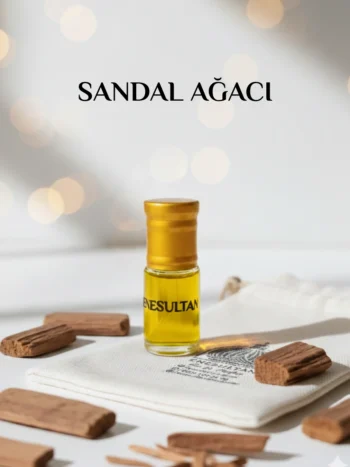
Sandal Ağacı (sandalwood) and Sedir Ağacı (cedarwood) perfume oils are two of the most reliable choices for candle making.
Soap Fragrance Oil: A Different Equation
Soap brings a different challenge than candles: an alkaline environment. In cold process soap, lye creates a high pH, and some scent molecules change or fade in it.
- Fragrance load: 3 to 5 percent of the oil weight. For 1 kg (about 2.2 lb) of oils, 30 to 50 g of fragrance oil.
- When to add: At “trace,” when the batter reaches a creamy consistency.
- Temperature: Around 95 to 113 °F (35 to 45 °C) is enough.
If you use a melt and pour soap base, it’s easier: there’s no lye to handle, you add the fragrance at around 140 °F (60 °C), and 2 to 3 percent is enough.
What to Watch for in Soap
- Acceleration: Spicy and some floral fragrance oils can make the batter seize suddenly. Test a new fragrance in a small batch first.
- Discoloration: Scents with vanilla turn soap brown over time. That’s normal, not spoilage.
- Curing: Cold process soap needs 4 to 6 weeks of curing. The scent settles in during this time.
- Skin safety: Soap is used on the skin; don’t exceed the recommended ratio.
Using Fragrance Oil in a Diffuser or Room Spray
This is the easiest way to use a perfume oil:
- Ultrasonic diffuser: 3 to 5 drops in the water reservoir. Add more for larger rooms.
- Reed diffuser: 15 to 20 ml of fragrance oil to 100 ml of carrier (diffuser base or DPG).
- Room spray: For 100 ml, 80 ml alcohol + 15 ml water + 5 ml fragrance oil.
- Burner: Drip onto a warm stone or cotton, not onto charcoal.
For full recipes, see our DIY reed diffuser and room spray guide.
Frequently Asked Questions
How much fragrance oil do you put in a candle?
6 to 10 percent of the wax weight. For 500 g of wax, 30 to 50 g of fragrance oil. More causes soot and hurts the burn.
At what temperature should I add fragrance oil to wax?
140 to 150 °F (60 to 65 °C) for soy wax and 158 to 167 °F (70 to 75 °C) for paraffin. Hotter and the top notes evaporate; cooler and the blend won’t be even.
Why doesn’t my candle smell?
The three most common reasons: it wasn’t cured (wait 1 to 2 weeks), the oil was added when the wax was too hot, or the ratio was too low.
Why does the scent fade in soap?
In cold process, high pH changes some molecules. Woody, amber and spicy notes hold up better in this environment.
Can you use perfume oil in candles?
Perfume oils are general-purpose and can be used in candles. Heat stability varies by note family, though; woody and amber scents give the most reliable results.
Summary
For candles: a 6 to 10 percent fragrance load, added at 140 to 150 °F for soy. For soap: 3 to 5 percent, added at trace. In both cases, don’t skip curing. Woody, amber and spicy notes are the most resistant to heat and alkali.
For perfume oils suited to these uses, visit our perfume oils page, and to get to know the scent families, read our amber and patchouli guides.
Scents for candles and soap
Perfume Oils

Perfume Oils


Essential Oils
